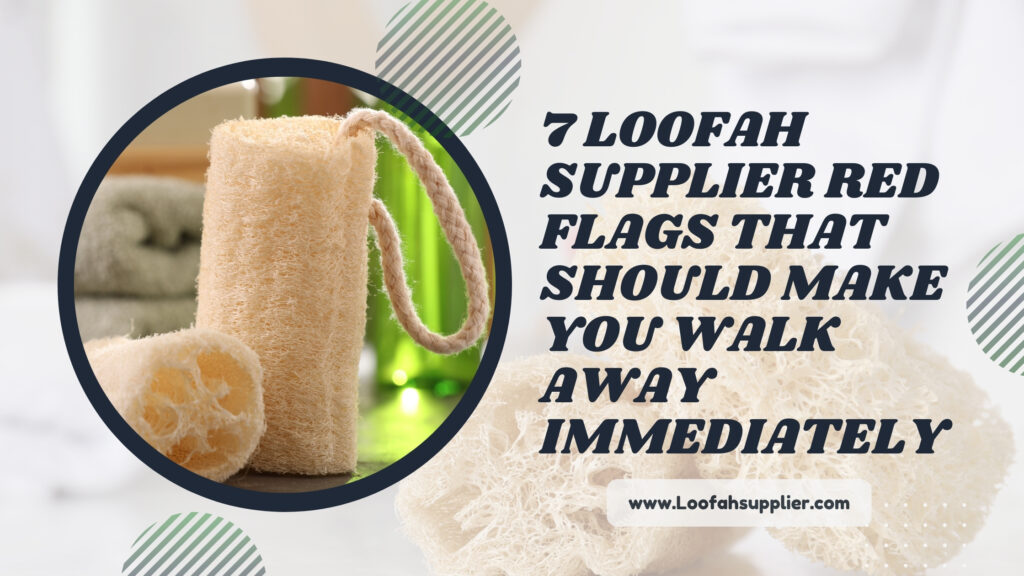
First-time loofah buyers can end up dissatisfied with their supplier. The reasons range from misleading product descriptions and hidden chemicals to inconsistent quality and zero accountability after the sale. Knowing the loofah supplier red flags warning signs before you commit your money is the difference between finding a partner you trust for years and wasting weeks dealing with returns, complaints, and damaged credibility.
This matters equally whether you run a spa that orders loofah in bulk or you are an individual shopper looking for a safe, natural exfoliator for your family. A bad supplier does not discriminate. They sell the same chemically bleached, low-density product to a retailer placing a large order as they do to a consumer buying a two-pack online. The consequences just scale differently. For a business, it means customer complaints, returns, and brand damage. For a consumer, it means skin irritation, a product that falls apart in a week, and money wasted on something marketed as natural that is anything but.
This guide breaks down the seven most critical loofah supplier red flags warning signs that experienced buyers watch for. You will learn exactly what to look for in product listings, supplier communications, quality documentation, and sourcing transparency. You will also find comparison tables, checklists, and evaluation criteria that make it simple to separate trustworthy suppliers from those you should avoid entirely.
If you want to skip straight to a supplier that exports Egyptian loofah, explore why buyers choose EGEXO and see what transparent sourcing looks like.
Red Flag 1: No Verifiable Farm or Cultivation Source
The single most telling warning sign is a supplier who cannot or will not tell you where their loofah is grown. Loofah is an agricultural product. It grows on vines, gets harvested at a specific maturity stage, and undergoes processing before it reaches you. Every legitimate supplier should be able to trace their product back to a specific growing region at minimum.
Why Origin Transparency Matters
Loofah quality is directly tied to where and how it is cultivated. Egyptian loofah grown in the Nile Delta is softer, with a looser fibre weave than Asian loofah. When a supplier cannot name their growing region, it usually means they are reselling product purchased from unknown middlemen with no quality oversight.
For wholesale buyers, this creates a supply chain you cannot audit or defend to your own customers. For individual consumers, it means you have no way to verify whether the product labeled as natural loofah is actually what it claims to be.
What a Trustworthy Supplier Provides Instead
A reliable supplier documents their cultivation process openly. EGEXO, for example, publishes their complete farm to export process so that both wholesale clients and individual buyers can see exactly how their loofah moves from Egyptian farmland to finished product. This kind of transparency is not a marketing gimmick. It is a baseline expectation that any serious supplier should meet.
Summary: If a supplier cannot tell you where their loofah is grown, they cannot vouch for its quality, purity, or consistency.
Want to judge the quality yourself? Request paid samples from EGEXO For Export, up to 20 pieces per item.
Red Flag 2: Refusing or Avoiding Sample Requests
Any supplier confident in their product will gladly send samples before asking you to commit to a larger purchase. This applies to wholesale buyers evaluating a potential new vendor and to consumers trying a brand for the first time. A supplier that pushes you to order without letting you physically inspect the product first is hiding something.
The Sample Test That Reveals Everything
When you receive a loofah sample, you can evaluate quality factors that no photograph or product description can communicate. Soak the sample in warm water. A quality loofah will soften evenly and feel firm yet flexible against skin. A low-quality product will become limp, shed fibers into the water, or develop an unusual chemical smell once wet.
Use the sample daily for several days. Good loofah maintains its structure and exfoliating texture. Inferior products begin deteriorating noticeably within the first few uses, losing fibers and compressing into a flat, ineffective shape.
How EGEXO Handles Sample Requests
EGEXO offers samples before you place an order. Request loofah samples. Samples are paid and the buyer pays the shipping. A sample order is up to 20 pieces per item. The sample cost is credited to your first order of $1,000 or more, placed within 60 days.
To see EGEXO’s products, browse the body loofah collection.
Red Flag 3: No Published Quality Standards
Quality control is fundamental to the loofah industry. A supplier with no published quality standards gives you no way to know what you will receive in a shipment.
A trustworthy supplier publishes its quality standards. At EGEXO, every product is checked before packing. See its loofah quality standards.
Why This Matters for Consumers Too
Even if you are buying a single loofah for personal use, a supplier that explains its quality checks helps you judge whether the price matches the product.
Summary: No published standards means no way to check quality. Walk away from any supplier who cannot explain its quality checks.
Red Flag 4: Suspiciously Low Pricing with No Explanation
Price is not the only factor in choosing a supplier, but pricing that seems dramatically below market rates should trigger immediate scrutiny. Natural loofah requires months of cultivation, manual harvesting, careful processing, and quality sorting. These steps have real costs. When a supplier undercuts the market by a wide margin, the savings almost always come from somewhere that hurts the end product.
Where Low-Cost Suppliers Cut Corners
| Cost-Cutting Method | Impact on Wholesale Buyers | Impact on Consumers |
|---|---|---|
| Harvesting loofah before full maturity | Lower fiber density, poor batch consistency | Product feels weak, deteriorates quickly |
| Skipping quality sorting | Mixed quality in every shipment, high rejection rates | Unpredictable product quality from purchase to purchase |
| Chemical bleaching to mask discoloration | Potential regulatory issues for retailers, customer complaints | Skin irritation risk, chemical residue on a product used on the body |
| Mixing synthetic fibers with natural loofah | Misrepresentation liability, sustainability claims undermined | Consumer unknowingly uses plastic-based product, defeats the eco purpose |
| Using untreated water in processing | Bacterial contamination risk in stored inventory | Hygiene risk |
| Eliminating post-harvest drying protocols | Mold development during shipping and storage | Musty smell, visible mold, unusable product on arrival |
For wholesale buyers evaluating multiple suppliers, always request a pricing breakdown that accounts for cultivation, processing, sorting, packaging, and shipping. A supplier who provides this level of detail is one who understands their own cost structure and prices honestly.
For consumers, remember that a natural loofah priced far below comparable products is rarely a bargain. It is usually a warning. Explore raw loofah scrubbers from EGEXO to see EGEXO’s wholesale prices.
Red Flag 5: No Customization, Private Labeling, or Flexibility
A supplier who only offers a fixed product list with no room for customization is typically a reseller rather than a manufacturer. Genuine loofah producers control their processing facilities and can adjust cutting dimensions, packaging formats, branding elements, and product configurations to meet buyer needs. Resellers purchase pre-made inventory and cannot modify anything because they do not control production.
What Customization Capability Signals
For wholesale buyers building a brand, customization is not a luxury. It is a business necessity. You need products cut to specific dimensions for your packaging, branded with your labels, and configured for your target market. A supplier who says they only offer standard sizes in standard packaging is telling you they have no production control.
EGEXO is a manufacturer offering private label loofah manufacturing and custom loofah product design services. This means they can produce loofah products to your exact specifications, from custom dimensions for subscription box fulfillment to branded packaging for retail shelf display.
How This Affects Consumer Product Quality
Even as an individual buyer, you benefit when your supplier is an actual manufacturer rather than a middleman. Manufacturers who control production invest in process improvements, maintain quality systems, and have direct accountability for every product that carries their name. Resellers have none of these incentives because they are simply passing through someone else’s inventory.
For the full range, see EGEXO’s Products page. Its loofah comes from its own farms and partner farms in the Nile Delta and is processed in its own factory.
Loofah Supplier Red Flags Warning Signs Checklist
Before committing to any loofah supplier, run through this evaluation checklist. It works for wholesale buyers vetting a new vendor and for consumers evaluating an online seller before placing an order.
| Evaluation Criteria | Green Light (Trustworthy) | Red Flag (Walk Away) |
|---|---|---|
| Origin disclosure | Names specific growing region, provides farm documentation | Vague or no origin information, claims multiple unverified origins |
| Sample availability | Offers samples proactively, encourages hands-on testing | Refuses samples, requires large minimum order before any testing |
| Pricing transparency | Provides cost breakdowns, pricing tiers are clearly explained | Prices significantly below market with no explanation |
| Customization capability | Offers custom sizing, private labeling, flexible packaging | Fixed product list only, no modifications available |
| Communication responsiveness | Replies within 24 to 48 hours, assigns dedicated contacts | Slow or inconsistent replies, generic responses, no named contact |
| Certifications and testing | Provides phytosanitary certificates and a certificate of origin on request | No documentation available, dismisses certification questions |
| Return and dispute policy | Clear written policy for quality disputes and returns | No policy published, vague verbal assurances only |
| Production facility evidence | Photos or videos of processing facility, invites facility visits | No production evidence, claims to be a manufacturer but cannot prove it |
| Client references | Provides references from existing wholesale clients | No references available, deflects when asked |
Summary: A trustworthy supplier passes every item on this checklist. If a supplier fails on even two or three criteria, consider it a serious loofah supplier red flags warning signs indicator and proceed with extreme caution.
Wholesale buyers ready to work with a supplier that meets every benchmark on this list can request a bulk quote from EGEXO and experience the difference transparent sourcing makes.
Red Flag 6: No Clear Communication Channel or Dedicated Support
Ordering loofah, whether a single product or a container-load shipment, involves questions. You might need to confirm dimensions, clarify lead times, request documentation, or resolve an issue with a received order. A supplier that is difficult to reach before the sale will be impossible to reach after it.
What Responsive Communication Looks Like
Legitimate wholesale suppliers assign dedicated account contacts for business clients. They respond to inquiries promptly, provide direct phone or messaging access, and proactively update you on order status without requiring you to chase information. For consumer purchases, trustworthy suppliers maintain accessible customer support channels with clear response time commitments.
Watch for these specific communication red flags. Emails that bounce or go unanswered for days. Phone numbers that ring to voicemail without callback. Social media accounts that post product photos but never respond to comments or messages. Contact forms that generate an auto-reply but no actual human follow-up. These patterns tell you exactly how the supplier will behave when you have a quality issue or a shipment problem that needs urgent resolution.
Pre-Sale Communication as a Quality Predictor
The way a supplier communicates before you place an order is a reliable preview of the relationship going forward. Ask specific questions about their products. Request documentation. Inquire about lead times for your volume needs. A supplier who answers thoroughly, promptly, and knowledgeably during the pre-sale phase is one who has invested in their team and their processes.
Red Flag 7: No Environmental or Sustainability Credentials
The entire appeal of natural loofah rests on its sustainability story. It is a plant-based, biodegradable, compostable alternative to plastic sponges and synthetic scrubbers. But that story only holds if the supplier actually practices sustainable cultivation and processing. A loofah supplier with no environmental credentials, no documentation of sustainable practices, and no commitment to sustainable processing undermines the very reason most buyers choose natural loofah in the first place.
Sustainability Claims vs Sustainability Evidence
| Sustainability Factor | Verified Practice (Trustworthy) | Unverified Claim (Red Flag) |
|---|---|---|
| Cultivation method | Describes farming methods, names growing region | Claims “natural” without any farming documentation |
| Processing chemicals | Publishes processing methods, confirms no chlorine bleaching | Product arrives unnaturally white, no processing info available |
| Water management | Describes water sourcing and treatment in processing facilities | No information about processing facility practices |
| Waste management | Uses loofah by-products (seeds for oil, fiber scraps for compost) | No mention of waste practices, likely discards usable material |
| Packaging materials | Uses recyclable, compostable, or minimal packaging | Excessive plastic packaging that contradicts sustainability positioning |
| Carbon footprint awareness | Consolidates shipments, optimizes logistics, reports on emissions efforts | No logistics transparency, ships small quantities inefficiently |
| Community impact | Employs local farming communities, supports regional agriculture | No mention of labor practices or community relationships |
Egyptian loofah is a plant crop grown in the Nile Delta. EGEXO describes its farm to export process from the farm to delivery.
Why Consumers Should Demand Proof
If you are switching from plastic sponges to natural loofah specifically for environmental reasons, the supplier’s sustainability practices should matter as much as the product itself. A loofah that was bleached with harsh chemicals, processed in a facility with no waste management, and shipped in plastic packaging has a far larger environmental footprint than its natural origins suggest. Asking for evidence is not being difficult. It is being a responsible consumer.
For pet and spa products, see EGEXO’s pet and spa grooming loofah category.
How to Verify a Loofah Supplier Before You Commit
Knowing the red flags is only half the equation. You also need a practical process for verifying suppliers efficiently. Here is a step-by-step approach that works for both wholesale buyers evaluating a new vendor and consumers researching an unfamiliar brand.
Step-by-Step Supplier Verification Process
| Step | Action | What You Are Looking For | Time Required |
|---|---|---|---|
| 1 | Review the supplier website thoroughly | Origin information, quality documentation, facility photos, team details | 30 to 60 minutes |
| 2 | Request product samples | Physical product quality, consistency across units, packaging presentation | Depends on the supplier and the shipping method |
| 3 | Ask for quality certifications | Phytosanitary certificates, certificate of origin, ISO certificates | 1 to 3 business days for supplier response |
| 4 | Check communication responsiveness | Reply speed, answer quality, willingness to provide detailed information | Ongoing during evaluation |
| 5 | Request client references (wholesale buyers) | Contact existing clients, ask about consistency, reliability, dispute resolution | 1 to 2 weeks |
| 6 | Verify business registration and export licenses | Legal business entity, valid export permits, trade association memberships | 1 to 5 business days |
| 7 | Place a small trial order | Full order experience from placement through delivery and quality inspection | Depends on the origin and the shipping method |
| 8 | Evaluate post-sale support | Follow-up communication, handling of any issues, interest in ongoing relationship | 2 to 4 weeks after delivery |
This process requires an investment of time, but it protects you from the far greater cost of partnering with the wrong supplier. Wholesale buyers who skip verification often discover problems only after committing to large orders that are difficult or impossible to return. Consumers who skip research end up with products that irritate their skin, fall apart prematurely, or contain materials they were trying to avoid.
For wholesale buyers ready to evaluate EGEXO through this process, request the priced catalog on egexo.com as your starting point and then request samples to begin hands-on testing.
Advice from EGEXO
Since 2015, we have exported Egyptian loofah and watched the market evolve. The most important advice we give new buyers, whether they are ordering a few units or many, is to never skip the sample step. A photograph can make any loofah look good. Only your hands can tell you if the fiber density, texture, and structure meet the standard you need. We invite that scrutiny. Samples are paid, the buyer pays the shipping, and the sample cost is credited to your first order of $1,000 or more, placed within 60 days. Transparency is not a burden for a quality producer. It is a competitive advantage. Request a quote from EGEXO
Frequently Asked Questions
Q1: What are the most common loofah supplier red flags warning signs consumers should watch for?
A: The most critical loofah supplier red flags warning signs for consumers include no origin disclosure, refusal to provide samples, unnaturally white product suggesting chemical bleaching, pricing dramatically below market rates, and no published quality standards. If a loofah arrives with a chemical smell, sheds fibers immediately when wet, or deteriorates within the first week of use, these are signs the supplier cut corners during cultivation or processing.
Q2: How can wholesale buyers verify a loofah supplier is legitimate before placing a large order?
A: Wholesale buyers should follow an eight-step verification process. Request samples and test them for at least five days. Ask for phytosanitary certificates and a certificate of origin. Check communication responsiveness and ask for references from existing clients. Verify business registration and export licenses. Place a small trial order before committing to full volume. Suppliers who welcome this scrutiny, like EGEXO with their published quality standards, are the ones worth partnering with.
Q3: Why choose Egyptian loofah?
A: Egyptian loofah from the Nile Delta is softer, with a looser fibre weave than Asian loofah.
Q4: Is it normal for a loofah supplier to require a minimum order quantity?
A: Many suppliers set high minimum order quantities. EGEXO has no minimum order on standard products, and private label starts from 1,000 units. A red flag is a supplier who demands extremely high minimums with no flexibility, no sample option, and no willingness to discuss trial quantities for new clients.
Q5: How can I tell if a loofah has been chemically bleached?
A: Natural loofah ranges from light cream to golden brown in color. If a loofah is bright, uniform white, it has almost certainly been bleached. The smell test is also reliable. Soak the loofah for 10 minutes and sniff it. Chemical bleaching leaves a faint but detectable chlorine or chemical odor, especially when the product is wet. Natural loofah has a mild, earthy, plant-based scent or no scent at all. EGEXO’s standard loofah is not bleached. Bleaching is done only on request.
Q6: What certifications should a trustworthy loofah supplier have?
A: At minimum, a loofah export supplier should hold valid phytosanitary certificates confirming the product is free from pests and disease. Additional credibility markers include ISO management system certificates and a certificate of origin. Business registration documents and export licenses verify the supplier is a legal entity authorized to trade internationally.
Q7: How often should I replace my natural loofah, and does supplier quality affect replacement frequency?
A: Replace your loofah when it is worn. Rinse it thoroughly after each use and hang it in a ventilated area to dry completely between uses. Supplier quality affects how long your loofah stays effective.
Conclusion
Choosing the wrong loofah supplier costs more than money. It costs time, reputation, and trust, whether you are a business owner whose customers depend on consistent product quality or a consumer who deserves exactly what was promised. The seven red flags covered in this guide, from missing origin documentation and sample refusals to absent quality standards, suspicious pricing, no customization capability, poor communication, and unverified sustainability claims, form a complete warning system that protects you before problems start.
The loofah market has room for many suppliers, but only those who operate with full transparency, documented quality standards, and genuine cultivation expertise deserve your business. Egyptian loofah from the Nile Delta is softer, with a looser fibre weave than Asian loofah, and EGEXO has exported it since 2015.
Key Takeaways:
- Always verify a supplier’s cultivation origin and demand documentation before ordering.
- Never skip sample testing. Five days of hands-on evaluation prevents months of regret.
- Published quality standards, responsive communication, and sustainability evidence are non-negotiable standards for any supplier worth your trust.
- Chemical bleaching, suspiciously low pricing, and no customization capability are among the strongest loofah supplier red flags warning signs in the market today.
Ready to work with a transparent, verified Egyptian loofah supplier?
- For Wholesale Buyers: Request a quote or download our catalog
- For Samples: Request samples
Keep reading: how to request loofah samples and vetting a loofah supplier online.