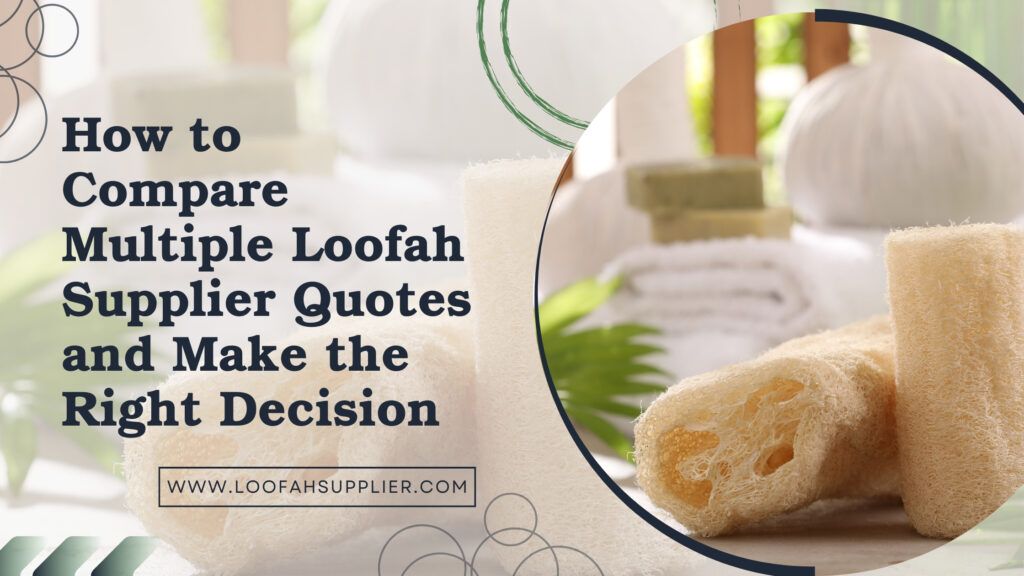
Over 72% of first-time loofah buyers say they regret not spending more time evaluating their options before placing an order. Whether you run a boutique spa sourcing natural exfoliators in bulk or you are an eco-conscious shopper picking your first plastic-free bath sponge, knowing how to compare loofah supplier quotes is the difference between a purchase you feel great about and one that disappoints.
The global natural loofah market continues to grow at roughly 8.5% annually, driven by mounting consumer demand for zero-waste alternatives and biodegradable personal care products. That growth means more suppliers than ever are competing for your attention. Some offer premium Egyptian loofah grown in nutrient-rich Nile Delta soil. Others sell mass-produced loofahs with vague sourcing claims and inconsistent quality. A few cut corners on hygiene standards, sustainability certifications, or both.
The challenge is real. A wholesale buyer reviewing five different quotes might see pricing gaps of 30% to 60% for what appears to be the same product. A consumer browsing online might wonder why one loofah costs three times more than another that looks nearly identical in photos. The answer almost always lives in the details that quotes either reveal or hide.
This guide walks you through exactly how to read, evaluate, and compare loofah supplier quotes so you make a decision rooted in facts rather than guesswork. You will learn which quality indicators to prioritize, what red flags to watch for in pricing structures, how sustainability certifications affect long-term value, and why origin matters more than most buyers realize. By the end, you will have a clear framework that works whether you are ordering 5,000 units for a retail launch or choosing a single loofah for your morning routine.
Ready to start with a transparent quote from a trusted source? You can request a wholesale loofah quotation from Egexo to see what a detailed, honest quote looks like firsthand.
Why Learning to Compare Loofah Supplier Quotes Matters More Than Ever
The natural loofah industry looks simple on the surface. A gourd grows, gets harvested, dried, and shipped. But anyone who has purchased loofahs from multiple sources knows that quality varies wildly. Understanding why that variation exists is the first step toward making smarter buying decisions.
The Growing Complexity of the Loofah Supply Chain
Natural loofah (Luffa aegyptiaca) is cultivated in tropical and subtropical climates, with Egypt, China, India, and parts of Central America serving as primary growing regions. Each region produces loofah with different fiber characteristics, durability profiles, and levels of processing refinement. Egyptian loofah, particularly from the Nile Delta, consistently ranks as the best loofah available worldwide due to its dense fiber structure, natural elasticity, and superior durability that can last 8 to 12 weeks with proper care.
When suppliers from different regions submit quotes, they may use similar product descriptions while delivering vastly different quality. A “Grade A bath loofah” from one supplier might match a “Grade B” from another. Without standardized industry-wide grading, buyers must learn to evaluate beyond the label.
What Both Buyers and Consumers Stand to Lose
For wholesale buyers, choosing the wrong supplier can mean receiving a container of loofahs that crumble within two weeks of use, triggering returns and damaging your brand reputation. For individual consumers, it might mean spending money on a loofah marketed as organic and sustainable that was actually bleached with harsh chemicals and grown using synthetic fertilizers.
In either case, the cost of a poor decision extends far beyond the purchase price. Learning to properly evaluate quotes protects your investment, your customers, and your commitment to sustainability. For deeper insight into what separates quality suppliers from the rest, explore why Egexo stands apart in the loofah industry.
The Anatomy of a Loofah Supplier Quote: What Every Line Item Tells You
Before you can meaningfully compare loofah supplier quotes, you need to understand what a complete quote should contain. A professional supplier provides far more than a unit price. Each element of the quote reveals something about the supplier’s transparency, expertise, and reliability.
Essential Components of a Professional Loofah Quote
A thorough quote includes product specifications, pricing tiers, minimum order quantities, shipping terms, lead times, and certification details. When any of these elements are missing, it often signals that the supplier is either inexperienced or intentionally vague. Here is what a complete quote should cover.
Loofah Supplier Quote Components Table
| Quote Element | What It Should Include | Why It Matters | Red Flag If Missing |
|---|---|---|---|
| Product Description | Exact loofah type, grade, cut style, dimensions | Ensures you receive what you expect | Could receive wrong product type |
| Quality Grade | Clear grading system (Premium, Grade A, Grade B) | Determines durability and performance | No quality accountability |
| Dimensions and Weight | Length, diameter, weight per unit or per batch | Critical for packaging and retail display planning | Inconsistent product sizing likely |
| MOQ (Minimum Order Quantity) | Stated minimums per SKU and per order | Affects budget planning and inventory risk | Hidden minimums may appear later |
| Unit Pricing | Price per piece at each volume tier | Enables accurate cost comparison | Inflated or misleading pricing |
| Shipping Terms | FOB, CIF, or DDP with named port | Determines who pays what in transit | Unexpected freight costs |
| Lead Time | Production and shipping timeline in days or weeks | Impacts your inventory and launch planning | Delays without accountability |
| Certifications | Organic, fair trade, phytosanitary, or FDA compliance | Validates sustainability and safety claims | Unverified quality and safety |
| Customization Options | Private labeling, custom sizing, packaging choices | Determines brand-building potential | Limited flexibility and scalability |
| Sample Policy | Sample availability, cost, and timeline | Lets you verify quality before committing | Supplier may be hiding quality issues |
Reading Between the Lines
The details a supplier chooses to include or omit tell a story. A quote that lists only price and quantity is doing the minimum. A quote that includes fiber density ratings, moisture content specifications, detailed photos of each grade, and references to documented quality standards shows a supplier who takes their product seriously.
Egexo, with over 25 years of Egyptian loofah cultivation experience, provides quotes that include product photography, grade breakdowns, full certification documentation, and transparent pricing at every volume level. That level of detail is not just helpful. It is what professional sourcing looks like.
Step-by-Step Process to Compare Loofah Supplier Quotes Effectively
Having a structured evaluation method removes emotion from the decision and lets the data guide you toward the right supplier. Follow this proven process whether you are comparing quotes for a 10,000-unit wholesale order or evaluating a few different brands for personal use.
Step 1: Standardize Your Requirements First
Before requesting any quotes, define exactly what you need. Wholesale buyers should specify the loofah type (body, kitchen, raw, or specialty), desired dimensions, target quality grade, estimated annual volume, and any packaging or labeling requirements. Consumers should clarify their intended use, preferred size, and whether they prioritize firmness or softness in their exfoliation texture.
This clarity ensures every quote you receive addresses the same baseline, making comparison meaningful rather than random.
Step 2: Request Quotes from at Least Three Suppliers
The sweet spot for comparison is three to five suppliers. Fewer than three limits your perspective. More than five creates analysis paralysis without adding proportional insight. Make sure your selection includes at least one Egyptian loofah supplier, as Egyptian-grown loofah consistently sets the benchmark for fiber quality and product longevity.
Step 3: Normalize Pricing for Fair Comparison
Raw unit prices often mislead because they exclude shipping, customs, packaging, and handling fees. Convert every quote to a landed cost per unit that includes all expenses from the supplier’s facility to your door. This single number makes comparison instant and accurate.
Landed Cost Calculation Process
| Step | Action | Example |
|---|---|---|
| 1 | Note the quoted unit price | 0.85 USD per piece |
| 2 | Add packaging cost per unit | 0.10 USD per piece |
| 3 | Calculate shipping cost per unit | Total freight divided by total units |
| 4 | Add customs and duties per unit | Based on your import country’s tariff code |
| 5 | Include inspection or certification fees per unit | If applicable |
| 6 | Sum all costs for total landed cost | This is your true cost per piece |
For consumers, the equivalent of landed cost is the total price you pay including shipping and taxes at checkout. Always compare the final out-the-door price rather than the listed product price alone.
Step 4: Score Each Supplier on Quality Indicators
Price means nothing without quality context. A loofah that costs 40% less but falls apart in half the time is actually more expensive per use. Build a simple scoring matrix using the criteria outlined in the next section and rate each supplier objectively.
Step 5: Request and Test Samples
Never commit to a large order without testing physical samples first. Professional suppliers like Egexo make this easy. You can order loofah samples to evaluate texture, durability, fiber density, and overall craftsmanship before making a volume commitment.
Critical Quality Factors When You Compare Loofah Supplier Quotes
Price comparison without quality comparison is meaningless. Two suppliers can quote the same unit price while delivering products separated by miles in performance and lifespan. Here are the quality markers that experienced buyers and informed consumers evaluate.
Fiber Density and Structure
The density of the loofah fiber network determines how well the product exfoliates, how long it holds its shape, and how resistant it is to premature breakdown. Egyptian loofah from the Nile Delta region achieves a fiber density that is measurably superior to loofah grown in most other regions, thanks to the combination of mineral-rich alluvial soil, consistent growing temperatures, and generations of refined cultivation technique.
When reviewing quotes, ask suppliers to specify fiber density or provide close-up images showing the internal cell structure. Premium-grade loofah displays tight, uniform cell walls with consistent spacing throughout the sponge.
Processing and Hygiene Standards
How a loofah is processed after harvest directly impacts safety and shelf life. Proper processing involves thorough cleaning, seed removal, controlled drying to the correct moisture content, and quality sorting. Suppliers who follow the complete farm to export process with documented quality controls at each stage deliver a safer, more reliable product.
Ask every supplier what cleaning agents they use, how they control moisture content, and whether they conduct microbial testing on finished products. These are not unreasonable questions. They are standard due diligence.
Loofah Quality Grade Comparison Table
| Quality Factor | Premium Grade | Grade A | Grade B | Economy Grade |
|---|---|---|---|---|
| Fiber Density | Very high, tight cells | High, mostly uniform | Moderate, some variation | Low, loose structure |
| Expected Lifespan | 8 to 12 weeks | 6 to 8 weeks | 4 to 6 weeks | 2 to 4 weeks |
| Color Consistency | Even golden tone | Mostly consistent | Some discoloration | Uneven coloring |
| Structural Integrity | Holds shape throughout use | Minor softening over time | Noticeable breakdown by week 4 | Frays and tears quickly |
| Seed Remnants | Zero | Rare, less than 1% | Occasional | Common |
| Best For | Luxury spas, premium retail, eco brands | Quality retailers, wellness centers | Budget retail, promotional use | Single-use applications |
| Typical MOQ | 500 to 1,000 units | 1,000 to 3,000 units | 2,000 to 5,000 units | 5,000+ units |
For individual consumers, understanding this grading system helps you decode what you are actually getting when a product is labeled “premium” versus “natural.” If a retailer sells a loofah at a premium price point but cannot specify its quality grade or origin, that is worth questioning.
Browse Egexo’s full range of bath and body loofahs to see how premium Egyptian loofah is presented with full grade transparency.
Sustainability Verification: The Factor Most Buyers Overlook in Quotes
Green claims are everywhere in the natural products industry, but not all sustainability promises hold up under scrutiny. When you compare loofah supplier quotes, the environmental credentials of each supplier should carry as much weight as price and quality.
What Genuine Sustainability Looks Like in Loofah Sourcing
Truly sustainable loofah production starts at the farm. It involves crop rotation practices that protect soil health, minimal or zero synthetic pesticide use, efficient water management, and fair labor conditions for agricultural workers. After harvest, sustainable processing avoids chlorine bleaching, uses biodegradable cleaning solutions, and minimizes packaging waste.
Egexo’s farms in Egypt exemplify this approach. With over 25 years of cultivation experience, they have refined growing practices that work with the Nile Delta ecosystem rather than against it. Their loofah is naturally sun-dried, cleaned with food-safe solutions, and packed using recyclable materials.
Sustainability Evaluation Checklist for Supplier Quotes
| Sustainability Criteria | What to Ask or Verify | Strong Indicator | Weak Indicator |
|---|---|---|---|
| Growing Practices | Are synthetic pesticides or fertilizers used? | Organic or low-chemical cultivation documented | No information available or vague claims |
| Water Usage | What irrigation methods are employed? | Drip irrigation or natural flood irrigation | No data or excessive water use |
| Processing Chemicals | Are chlorine or harsh bleaches used? | Food-safe, biodegradable cleaning agents only | Bright white product color (suggests heavy bleaching) |
| Packaging Materials | What packaging is used for shipping and retail? | Recyclable, compostable, or minimal packaging | Excessive plastic wrapping |
| Carbon Footprint | Does the supplier measure or offset emissions? | Published sustainability reports or carbon data | No awareness of environmental impact |
| Labor Practices | Are workers paid fairly with safe conditions? | Fair trade certification or documented labor policies | No labor information provided |
| Certifications | Which third-party verifications does the supplier hold? | Organic, fair trade, or environmental certifications | Self-declared “eco-friendly” without documentation |
| Waste Management | How are production scraps and seconds handled? | Composted, repurposed, or donated | Sent to landfill or not addressed |
For more guidance on choosing genuinely sustainable loofah products, the editorial team at Loofah Guide publishes regular consumer-focused reviews and comparisons.
Why Egyptian Loofah Leads in Sustainability
Egyptian loofah is widely recognized as the best loofah for environmentally conscious buyers. The Nile Delta’s natural fertility reduces the need for synthetic inputs. The warm, dry climate enables sun drying rather than energy-intensive mechanical drying. And Egypt’s long history of loofah cultivation means farming communities have generations of knowledge about growing high-quality loofah without depleting the land.
When sustainability is a core value for your brand or your household, sourcing Egyptian loofah from established producers like Egexo is one of the most reliable decisions you can make. Their commitment to environmental stewardship is documented throughout their quality standards page.
Supplier Evaluation Beyond the Quote: Trust Signals That Reveal True Reliability
A quote is a snapshot of a potential transaction. A supplier relationship is an ongoing commitment. To choose wisely, look beyond the numbers and evaluate the signals that indicate whether a supplier will deliver consistently over time.
Experience and Track Record
There is no substitute for experience in the loofah industry. A supplier with 25 or more years in the business has weathered supply disruptions, shipping challenges, quality fluctuations due to weather, and shifting market demands. They have systems in place for every scenario because they have encountered every scenario. Egexo’s quarter-century track record in Egyptian loofah production is not just a number. It represents thousands of fulfilled orders and deep expertise in every stage from seed selection to final shipment.
Customization and Private Label Capabilities
If you are building a brand around natural bath and body products, your supplier’s ability to customize matters. Can they produce loofahs in specific shapes, sizes, or cut styles? Do they offer private label loofah manufacturing with your branding on the packaging? Can they collaborate on custom loofah product design for unique product lines?
These capabilities transform a supplier from a commodity vendor into a strategic partner. They also add complexity to quote comparison because not every supplier can offer the same level of service. When evaluating quotes, note which suppliers provide a la carte customization options and which offer fully integrated solutions.
Communication Quality and Responsiveness
How a supplier communicates during the quoting process tells you how they will communicate during production, shipping, and problem resolution. Suppliers who respond within 24 to 48 hours, answer questions with specificity, and proactively share information demonstrate the kind of professionalism that makes long-term partnerships work.
If a supplier takes a week to respond to a quote request or provides vague answers to detailed questions, treat that as a preview of the service you will receive after you send payment.
Product Range and Versatility
A supplier with a broad product range typically has deeper expertise and more flexible manufacturing capability. Egexo, for example, supplies everything from raw loofah scrubbers and kitchen loofahs to pet and spa grooming loofahs. This diversity shows a supplier who understands different market segments and can support buyers as their product lines expand.
For consumers, a supplier or brand offering a wide range of loofah types typically signals genuine expertise rather than a single opportunistic product launched to ride a trend. You can explore the full Egexo collection at their online shop to see the breadth of what a serious supplier offers.
Common Mistakes Buyers Make When Comparing Loofah Quotes
Even experienced procurement professionals fall into traps when evaluating loofah supplier proposals. Recognizing these common mistakes helps you avoid them.
Choosing Price Over Total Value
The lowest quote almost never represents the best value. A rock-bottom price usually means thinner fiber density, shorter product lifespan, questionable processing standards, or unreliable delivery timelines. Calculating the cost per use rather than cost per unit reveals the true economics. A premium Egyptian loofah lasting 10 weeks at 1.50 USD costs roughly 0.15 USD per use. An economy loofah lasting 3 weeks at 0.60 USD costs 0.20 USD per use. The “expensive” option is actually cheaper.
Ignoring Origin and Traceability
A quote that does not specify where the loofah was grown should raise immediate questions. Origin determines fiber quality, growing conditions, pesticide exposure, and ethical labor practices. Suppliers who are proud of their source, like those farming premium loofah in Egypt’s Nile Delta, make origin a featured element of their quote, not a detail they avoid mentioning.
Skipping the Sample Stage
Approximately 35% of first-time wholesale buyers skip sample testing to save time, according to industry surveys. Of those, nearly half report quality issues with their first production order. Samples cost a fraction of a full order and can prevent costly mistakes. Always request loofah samples before committing to volume.
Comparing Non-Equivalent Products
Not all body loofahs are the same product. A 15-centimeter cylindrical loofah and a 20-centimeter flat-cut loofah serve different purposes and carry different production costs. Make sure you are comparing identical or closely equivalent products when evaluating quotes. Standardize your comparison by product type, grade, and dimensions.
For wholesale sourcing strategies and bulk pricing insights, the team at Wholesale Loofah maintains a library of resources tailored specifically to business buyers navigating the supplier landscape.
FAQ Section
Q1: What is the best way to compare loofah supplier quotes for wholesale orders?
A: The most effective way to compare loofah supplier quotes is to calculate the landed cost per unit, which includes the quoted price plus shipping, customs duties, packaging, and handling. Then score each supplier on quality grade, certifications, lead time, MOQ flexibility, and communication responsiveness. Always request physical samples before placing a production order to verify that the quoted quality matches reality.
Q2: Why is Egyptian loofah considered the best quality?
A: Egyptian loofah, especially from the Nile Delta region, benefits from exceptionally fertile alluvial soil, consistent subtropical temperatures, and generations of refined farming expertise. These conditions produce loofah with higher fiber density, greater elasticity, and longer usable lifespan than loofah grown in most other regions. Premium Egyptian loofah typically lasts 8 to 12 weeks, compared to 2 to 5 weeks for economy-grade alternatives from other origins.
Q3: What MOQ should I expect when ordering wholesale loofahs?
A: Minimum order quantities vary by supplier and product grade. For premium-grade Egyptian loofah, MOQs typically start at 500 to 1,000 units per product type. Grade A orders often begin at 1,000 to 3,000 units. Economy grades may require 5,000 units or more to justify production runs. Established suppliers like Egexo offer flexible MOQs for first-time buyers and can scale with your business as order volumes grow.
Q4: How can individual consumers evaluate loofah quality before buying?
A: Look for specific quality indicators including tight and uniform fiber cell structure, a consistent natural golden color without bright white bleaching, minimal seed remnants, and a firm yet slightly flexible texture when dry. Check whether the retailer or brand specifies the loofah’s country of origin, quality grade, and expected lifespan. Products that provide this transparency typically come from more reputable suppliers.
Q5: What certifications should a loofah supplier have?
A: At minimum, a professional loofah supplier should provide phytosanitary certificates confirming the product is pest-free for international shipping. Organic certifications add credibility for eco-conscious buyers. FDA compliance matters for products entering the United States market. Fair trade or ethical sourcing documentation demonstrates responsible labor practices. The more certifications a supplier holds, the more verified their claims become.
Q6: How long does a premium natural loofah last compared to cheaper alternatives?
A: A premium-grade Egyptian loofah maintained properly lasts 8 to 12 weeks of regular use. Grade A loofahs typically hold up for 6 to 8 weeks. Economy or budget loofahs often begin deteriorating within 2 to 4 weeks. Proper care, including rinsing after each use, hanging to dry in a ventilated area, and sanitizing weekly, extends the lifespan of any loofah regardless of grade.
Q7: Should I prioritize price or quality when comparing loofah supplier quotes?
A: Always prioritize total value over unit price. A low-priced loofah with short lifespan and high defect rates costs more per use than a moderately priced premium product. Calculate cost per use by dividing the landed unit cost by the expected number of uses. This metric consistently shows that mid-range and premium loofahs from established Egyptian suppliers like Egexo deliver the best return whether you are buying for resale or personal use.
Expert Insight from Egexo
With more than 25 years growing and exporting premium Egyptian loofah from the Nile Delta, we have seen thousands of buyers navigate the quoting process. The single most valuable piece of advice we give every new customer is this: do not evaluate a quote in isolation. A quote only becomes meaningful when placed next to others that cover the same specifications, the same volume, and the same delivery terms. We provide complete transparency in every quote we issue, including fiber density data, quality grade photography, and full certification documentation, because we know that when buyers compare honestly, Egyptian loofah quality speaks for itself. We also encourage every prospective buyer to start with samples. Seeing and feeling the product eliminates uncertainty faster than any spreadsheet ever could. Download our complete product catalog to review our full range of offerings before requesting your quote.
Conclusion
Knowing how to compare loofah supplier quotes is a skill that pays for itself whether you are sourcing thousands of units for a retail launch or choosing one great loofah for your bathroom. The process comes down to looking beyond surface-level pricing and examining the factors that determine real value: fiber quality, processing standards, sustainability credentials, supplier reliability, and total landed cost.
Egyptian loofah remains the gold standard in the industry, and Egexo’s 25 plus years of cultivation expertise, transparent quoting practices, and comprehensive quality documentation make them the benchmark against which other suppliers are measured. By following the structured comparison framework in this guide, you protect your budget, your customers, and your environmental values all at once.
Key Takeaways:
- Always calculate landed cost per unit, not just the quoted price, when comparing suppliers
- Score suppliers across at least 10 quality and service criteria using a standardized evaluation matrix
- Verify sustainability claims with documentation rather than trusting marketing language alone
- Request and test physical samples from your top two or three suppliers before placing production orders
- Prioritize cost per use over cost per unit to identify the best long-term value
Ready to experience Egyptian loofah quality?
- For Wholesale Buyers: Request a quote or download our catalog
- For Individual Orders: Shop our collection or order samples