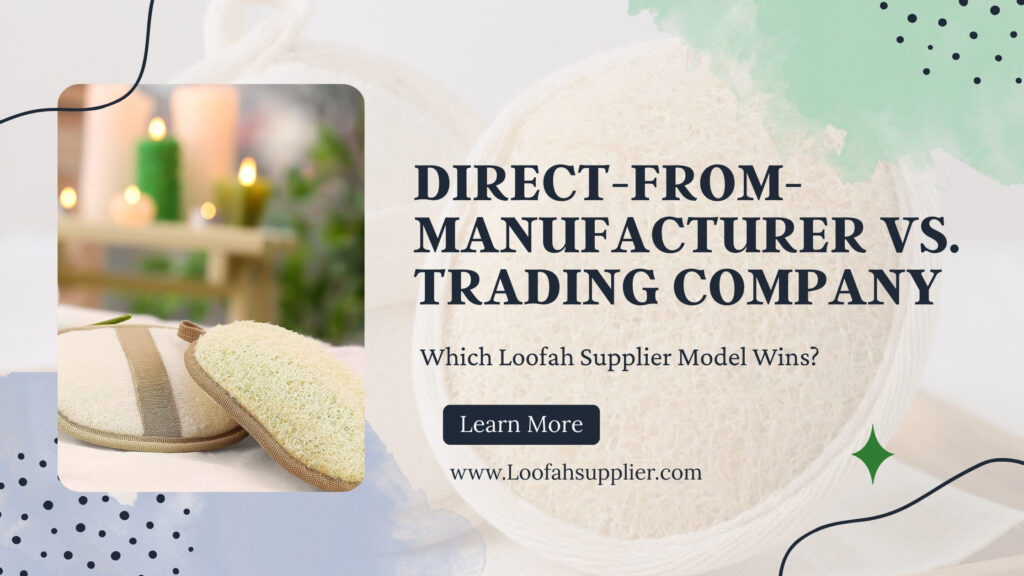
Here is a fact that catches most buyers off guard: roughly 60 percent of loofah products sold through trading companies pass through at least two middlemen before reaching the end customer. Each intermediary adds cost, reduces transparency, and creates another point where quality can slip without anyone noticing. Whether you run a spa that orders loofahs by the thousand or you are a consumer who simply wants a natural, sustainably grown bath sponge, the loofah manufacturer vs trading company decision affects the price you pay, the quality you receive, and the environmental footprint behind every product.
This is not just a supply chain technicality. It shapes the entire experience. A direct manufacturer controls every step from seed to shipment, which means they can guarantee fiber quality, processing standards, and sustainability claims with documentation you can actually verify. A trading company aggregates products from multiple sources, which can offer convenience but introduces inconsistency and a disconnect between the product story and the product reality.
In this guide, you will learn exactly how these two supplier models differ across pricing, quality control, customization, sustainability, and reliability. You will find comparison tables with concrete metrics, a supplier evaluation checklist you can use immediately, and a clear breakdown of which model serves different business needs and consumer priorities. We will also examine why Egyptian loofah consistently outperforms other origins and why Egexo, with over 25 years of Nile Delta cultivation experience, represents the gold standard in direct-from-manufacturer sourcing.
If you are evaluating suppliers right now, request a wholesale quote from Egexo to see what direct manufacturer pricing and quality look like in practice.
Understanding the Two Loofah Supplier Models
What Is a Direct Loofah Manufacturer?
A direct loofah manufacturer grows, processes, and exports loofah products from their own facilities. They own or directly manage the farms where Luffa aegyptiaca is cultivated, operate the processing and packaging lines, and handle export logistics. This vertical integration means the manufacturer has complete visibility and control over every stage of production.
For wholesale buyers, this translates to consistent quality across orders, the ability to customize products to exact specifications, and pricing that reflects actual production costs rather than stacked margins. For consumers, buying from brands that source directly from manufacturers means the product you hold in your hand can be traced back to a specific farm, a specific harvest, and a specific set of quality controls.
Egexo is a clear example of this model. Their operation spans the entire journey from farm to export, with cultivation in the nutrient-rich Nile Delta soil, in-house processing, quality grading, and direct shipment to buyers in over 30 countries.
What Is a Loofah Trading Company?
A trading company does not grow or process loofah. Instead, it sources finished or semi-finished products from multiple manufacturers and resells them. Trading companies act as intermediaries, connecting buyers with products from various origins and suppliers. They may offer a broad catalog and the convenience of a single point of contact for multiple product types.
The trade-off is reduced control. A trading company typically cannot guarantee batch-to-batch consistency because their supply sources may change. They may have limited ability to customize products because they do not control the manufacturing process. And their pricing includes their own margin on top of what the actual manufacturer charges, which means buyers pay more for every unit.
Loofah Manufacturer vs Trading Company: The Complete Comparison
Understanding the loofah manufacturer vs trading company decision requires looking at specific, measurable factors. The following comparison table breaks down the key differences across the criteria that matter most to both wholesale buyers and quality-conscious consumers.
Head-to-Head Comparison Table
| Factor | Direct Manufacturer | Trading Company |
|---|---|---|
| Price Transparency | Full visibility into production costs | Markup layers from multiple intermediaries |
| Quality Control | In-house testing at every production stage | Relies on manufacturer quality with limited oversight |
| Product Customization | Full custom design, sizing, branding, and packaging | Limited to what current suppliers can provide |
| MOQ Flexibility | Typically 200 to 500 units for standard products | Often higher due to aggregation requirements |
| Supply Consistency | Same farm, same process, same quality each order | Sources may change between orders |
| Lead Time | 2 to 6 weeks depending on order size | 4 to 10 weeks due to additional coordination |
| Sustainability Verification | Direct documentation from farm to shipment | Second-hand claims that are harder to verify |
| Communication Speed | Direct access to production team | Relayed through sales intermediaries |
| Private Label Capability | Full in-house branding and packaging | Depends on third-party manufacturer willingness |
| Traceability | Complete harvest-to-product documentation | Partial or unavailable in many cases |
The pattern is clear. Direct manufacturers offer superior control, transparency, and pricing efficiency. Trading companies can provide convenience and product variety, but at the cost of consistency, traceability, and margin.
For a detailed look at how Egexo maintains quality across every production stage, visit their quality standards documentation.
Why Pricing Differs Between Manufacturers and Trading Companies
The Real Cost Structure Behind Each Model
One of the most impactful differences in the loofah manufacturer vs trading company comparison is pricing. Understanding where your money goes helps both wholesale buyers calculate margins and consumers evaluate whether they are getting fair value.
When you buy from a direct manufacturer, the price reflects raw material costs, farming labor, processing and grading, packaging, and export logistics. There is one margin in the chain. When you buy from a trading company, you pay for all of those same costs plus the trading company’s sourcing fees, warehousing, sales overhead, and profit margin. Industry data suggests that trading company markups add between 15 and 40 percent to the final unit price compared to direct manufacturer pricing for equivalent quality.
How This Affects Business Margins
For wholesale buyers, this pricing gap directly impacts profitability. A spa owner purchasing 2,000 bath loofahs annually saves significantly by sourcing from a direct manufacturer. Those savings can be reinvested into marketing, product development, or simply preserved as profit.
For retailers building a private label loofah brand, the cost advantage of working directly with a manufacturer becomes even more pronounced. Private labeling through a trading company means paying the trading company’s margin and the manufacturer’s margin, while private labeling directly with the manufacturer eliminates that redundancy entirely.
| Cost Component | Direct Manufacturer | Trading Company |
|---|---|---|
| Raw material and farming | Included | Included (passed through) |
| Processing and grading | Included | Included (passed through) |
| Packaging and branding | Included | Included with additional coordination fees |
| Export logistics | Included or quoted separately | Included with markup |
| Intermediary margin | None | 15 to 40 percent added |
| Quality assurance overhead | Integrated into operations | Additional inspection costs may apply |
| Total buyer cost | Base production plus one margin | Base production plus two or more margins |
Consumers feel this too. When you purchase a loofah product from a brand that sources through trading companies, some of the price you pay covers intermediary costs rather than product quality. Brands sourcing directly from Egyptian manufacturers like Egexo can offer better products at competitive prices because the supply chain is leaner and more efficient.
Ready to compare pricing for yourself? Download the Egexo product catalog to see direct manufacturer pricing across all product categories.
Quality Control: Where the Manufacturer Advantage Becomes Undeniable
How Direct Manufacturers Maintain Consistent Quality
Quality control is perhaps the most critical differentiator in the loofah manufacturer vs trading company evaluation. A direct manufacturer manages quality at every stage because they own every stage. From selecting seed varieties to grading finished products, the manufacturer’s quality team is present, accountable, and responsive.
Egexo’s quality process illustrates this advantage. Their team inspects loofah fibers at harvest for density and maturity, monitors the sun-drying process to prevent mold development, grades each piece according to fiber uniformity and structural integrity, and conducts final inspection before packaging. This end-to-end oversight produces consistency that trading companies simply cannot match because they do not control the production environment.
Quality Grading Standards
Professional loofah grading uses specific criteria that buyers and consumers should understand. The following table outlines standard quality grades and what they mean for product performance.
| Quality Grade | Fiber Density | Color Uniformity | Structural Integrity | Best Use | Typical Availability |
|---|---|---|---|---|---|
| Premium A | Dense, tightly woven | Even golden to light tan | No soft spots, tears, or irregularities | Spa, luxury retail, body loofah | Direct manufacturers |
| Standard B | Moderate density | Minor color variation | Minimal imperfections | Retail, hospitality, general bath use | Both models |
| Economy C | Lighter density | Noticeable variation | May have minor soft areas | Kitchen cleaning, bulk hospitality | Both models |
| Raw Ungraded | Variable | Natural variation | Unprocessed, may need trimming | Raw scrubber products, DIY crafts | Both models |
Here is the key insight: Premium A grade loofah is consistently available from direct manufacturers who control their growing and grading processes. Trading companies may offer Premium A product, but the consistency of that grade across multiple orders depends on whichever manufacturer they happen to source from at the time. Your first order might be exceptional. Your fifth order might come from a different farm entirely.
For consumers shopping for personal use, this means that brands sourcing from direct manufacturers are more likely to deliver the same quality experience every time you repurchase. You can explore how this grading translates to actual products by browsing the Egexo shop.
Sustainability and Traceability: What Eco-Conscious Buyers Need to Know
The Sustainability Gap Between Supplier Models
Sustainability claims require proof, and proof requires traceability. This is where the loofah manufacturer vs trading company comparison becomes especially relevant for eco-conscious consumers and green brands building their reputation on environmental integrity.
A direct manufacturer can document every environmental claim with specific evidence. They can tell you which field the loofah was grown in, what agricultural inputs were used, how the product was processed, and what the carbon footprint of production looks like. This level of transparency allows brands to make credible sustainability claims and gives consumers confidence that their purchase aligns with their environmental values.
Trading companies face a structural limitation here. Because they source from multiple manufacturers, their sustainability documentation is second-hand at best. They may pass along certifications from their suppliers, but they cannot independently verify farming practices, water usage, chemical inputs, or processing methods at facilities they do not operate or regularly inspect.
Why Egyptian Loofah Leads in Sustainable Production
Egyptian loofah from the Nile Delta region holds a distinct sustainability advantage. The region receives over 3,000 hours of annual sunlight, enabling natural sun-drying that eliminates the need for energy-intensive mechanical drying. The alluvial soil deposited by the Nile is naturally fertile, reducing dependence on synthetic fertilizers. And traditional Egyptian farming practices passed through generations prioritize soil health and water efficiency.
Egexo’s cultivation methods embody these advantages. Their farms use natural irrigation patterns, organic soil management, and manual harvesting techniques that minimize environmental impact while maximizing fiber quality. Learn more about why Egexo represents the best in sustainable loofah production.
For consumers who care about the environmental impact of their purchases, choosing products sourced directly from Egyptian manufacturers provides the highest level of sustainability assurance. For brands marketing eco-friendly and zero-waste products, direct manufacturer sourcing gives you the documented evidence your customers demand.
Consumer resources for understanding sustainable loofah practices are available at loofahguide.com, and wholesale buyers exploring sustainable sourcing options can find additional market data at wholesaleloofah.com.
Supplier Evaluation Checklist: How to Choose the Right Model for Your Needs
For Wholesale Buyers Evaluating Loofah Suppliers
Use this checklist when assessing any potential loofah supplier, whether they present themselves as a manufacturer or a trading company. Each criterion helps you identify which model you are actually dealing with and whether the supplier meets professional sourcing standards.
| Evaluation Criteria | What to Ask or Verify | Manufacturer Indicator | Trading Company Indicator |
|---|---|---|---|
| Farm ownership or management | Do you own or directly manage the loofah farms? | Yes, with location details and photos | No, sources from external farms |
| Processing facility | Can you provide a facility tour or virtual walkthrough? | Yes, in-house facility available | May show partner facilities or none |
| Quality control process | Describe your QC steps from harvest to shipment | Detailed multi-stage process documentation | General quality claims without process specifics |
| Customization capability | Can you create custom sizes, shapes, or packaging? | Yes, with design consultation included | Limited, depends on current supplier capacity |
| Certifications | Provide current phytosanitary, organic, or safety certs | Issued in their name for their facility | Issued in another company’s name |
| MOQ flexibility | What are your minimum order quantities? | Flexible, often 200 to 500 units | Higher minimums due to aggregation needs |
| Lead time transparency | What determines your production timeline? | Based on their own production schedule | Based on supplier availability they cannot control |
| Sample availability | Can you send product samples before order commitment? | Yes, from current production stock | Samples may not match final delivery source |
| Traceability documentation | Can you trace this product to a specific harvest? | Complete lot tracking from field to package | Partial or unavailable |
| Price breakdown | Can you itemize production vs logistics costs? | Transparent cost structure | Bundled pricing with unclear margins |
This checklist works equally well for individual consumers evaluating brands. If a loofah brand cannot answer these questions about their supplier, they may not have the supply chain transparency needed to back up their quality or sustainability claims.
To test direct manufacturer quality firsthand, order samples from Egexo and evaluate the product against any other supplier in your current sourcing portfolio.
Customization and Private Labeling: The Manufacturer’s Domain
Why Custom Products Require Direct Manufacturer Relationships
Custom loofah products are a growing segment of the market. Spa owners want branded loofah products that match their aesthetic. Retailers want exclusive shapes and sizes that differentiate their shelves. Even individual consumers increasingly seek out specialty items like pet grooming loofahs or kitchen-specific scrubbers that require thoughtful product design.
A direct manufacturer can deliver on these needs because they control the production process. They can adjust loofah dimensions, modify processing techniques, create custom packaging, and apply private label branding without coordinating across multiple parties. Egexo offers both private label manufacturing and custom product design services that take concepts from initial sketches through finished products ready for retail.
Trading companies face inherent limitations here. Any customization request must be relayed to whichever manufacturer they are currently sourcing from. If that manufacturer cannot accommodate the request, the trading company must find another supplier, which introduces delays and quality uncertainty. Complex custom projects often require direct collaboration between the buyer and the production team, something a trading company structure does not support efficiently.
Custom Product Development Process
| Step | Direct Manufacturer Timeline | Trading Company Timeline |
|---|---|---|
| 1. Initial concept discussion | 1 to 3 days | 3 to 7 days (relayed communication) |
| 2. Design and specifications | 3 to 5 days | 7 to 14 days |
| 3. Prototype or sample creation | 5 to 10 days | 14 to 30 days |
| 4. Sample approval and revision | 2 to 5 days | 7 to 14 days |
| 5. Production run | 10 to 21 days | 21 to 45 days |
| 6. Quality inspection and shipping | 3 to 7 days | 7 to 14 days |
| Total estimated timeline | 24 to 51 days | 59 to 124 days |
The timeline difference alone can determine whether a product launches on schedule or misses its market window. For seasonal products, retail promotions, or spa openings, this gap is significant.
Consumers benefit from the direct manufacturer model indirectly but meaningfully. When brands work directly with manufacturers, they can bring innovative products to market faster. Specialty items like pet and spa grooming loofahs exist in today’s market largely because direct manufacturer relationships made product development practical and cost-effective.
When a Trading Company Might Make Sense
Situations Where Intermediaries Add Value
Despite the clear advantages of direct manufacturer sourcing, there are specific scenarios where a trading company model serves a legitimate purpose. Acknowledging this provides a complete picture of the loofah manufacturer vs trading company landscape.
Small buyers who need very low quantities of multiple product types from different origins may find a trading company convenient as a single-source solution. Buyers entering the loofah market for the first time and still exploring product categories may use trading companies as a discovery platform before establishing direct manufacturer relationships. And buyers in regions where import regulations are particularly complex may benefit from a trading company that specializes in navigating those requirements.
However, these advantages diminish quickly as order volumes grow, quality expectations increase, or sustainability documentation becomes necessary. Most serious wholesale operations outgrow the trading company model within their first year of loofah sourcing because the limitations in quality consistency, pricing, and customization become too costly to accept.
For buyers ready to move beyond intermediaries, request a wholesale quotation directly from Egexo and experience the difference that direct manufacturer access creates.
FAQ Section
Q1: What is the main difference between a loofah manufacturer and a trading company?
A: A loofah manufacturer grows, processes, and exports loofah products from their own facilities, giving them complete control over quality, pricing, and customization. A trading company purchases finished products from various manufacturers and resells them, acting as an intermediary. The loofah manufacturer vs trading company distinction affects product consistency, price transparency, and the ability to verify sustainability claims.
Q2: Do direct loofah manufacturers offer lower prices than trading companies?
A: Yes, direct manufacturers typically offer prices 15 to 40 percent lower than trading companies for equivalent quality because they eliminate intermediary markups. Buyers pay only the production cost plus a single margin rather than stacked margins from multiple parties in the supply chain. This price advantage increases with larger order volumes.
Q3: Can individual consumers buy directly from loofah manufacturers?
A: Many direct loofah manufacturers, including Egexo, sell to both wholesale buyers and individual consumers. Consumers can purchase single units or small quantities through the manufacturer’s online shop while benefiting from the same quality standards applied to bulk orders. This gives consumers access to manufacturer-grade quality without needing wholesale quantities.
Q4: How can I tell if my loofah supplier is a real manufacturer or a trading company?
A: Ask for farm location details, processing facility photos or tours, certifications issued in their company name, and the ability to customize products. A genuine manufacturer can provide all of these. A trading company will typically offer general product photos, certifications in another company’s name, and limited customization options.
Q5: Why is Egyptian loofah considered the best quality in the world?
A: Egyptian loofah from the Nile Delta grows in mineral-rich alluvial soil with over 3,000 hours of annual sunlight, producing fibers with superior density, elasticity, and durability. Combined with generations of cultivation expertise and established export infrastructure, Egyptian loofah consistently outperforms loofah from other regions in independent quality testing and buyer satisfaction ratings.
Q6: What MOQ should I expect from a direct loofah manufacturer?
A: Direct loofah manufacturers typically set MOQs between 200 and 500 units for standard products, though this varies by product type and customization requirements. Trading companies often require higher minimums because they aggregate orders across suppliers. Some manufacturers like Egexo offer flexible MOQs for first-time buyers and sample orders to help businesses evaluate quality before committing to large volumes.
Q7: Is it possible to get private label loofah products from a trading company?
A: While some trading companies offer basic private labeling, the process is slower, less flexible, and more expensive than working directly with a manufacturer. A trading company must coordinate labeling and packaging through a third-party manufacturer, adding time and cost. Direct manufacturers handle all branding in-house, offering faster turnaround, greater design flexibility, and tighter quality control over the finished branded product.
Expert Insight from Egexo
With more than 25 years of cultivating and exporting Egyptian loofah from the Nile Delta, we have worked with thousands of buyers who initially sourced through trading companies before switching to direct manufacturer relationships. The most common reason for the switch is not pricing, though the savings are significant. It is consistency. When you source through a trading company, your third order might come from a completely different farm than your first, and your customers will notice the difference even if you do not. At Egexo, every order traces back to our own cultivation and processing operation. The loofah your customers loved the first time is the same loofah they receive every time. That consistency is what builds brands and keeps customers coming back.
Conclusion
The loofah manufacturer vs trading company decision is not just a procurement detail. It is a strategic choice that determines your product quality, profit margins, sustainability credibility, and customer satisfaction over the long term. Direct manufacturers offer superior quality control through vertical integration, transparent pricing without intermediary markups, full customization and private label capabilities, verified sustainability documentation from farm to finished product, and consistent quality across every order. Trading companies can serve as a starting point for new buyers exploring the market, but most businesses and quality-conscious consumers ultimately benefit from direct manufacturer relationships. Egyptian loofah from the Nile Delta, produced by established manufacturers like Egexo, represents the highest global standard for fiber quality, sustainability, and supply chain transparency.
Key Takeaways:
- Direct manufacturers offer 15 to 40 percent better pricing by eliminating intermediary markups from the supply chain.
- Quality consistency requires end-to-end production control that only a direct manufacturer can provide.
- Sustainability claims need traceable documentation that originates at the farm level, something trading companies cannot independently verify.
- Custom and private label products develop two to three times faster through direct manufacturer partnerships than through trading companies.
- Egyptian loofah from certified manufacturers like Egexo sets the global benchmark for natural loofah quality.
Ready to experience the direct manufacturer difference?
- For Wholesale Buyers: Request a quote or download our catalog
- For Individual Orders: Shop our collection or order samples