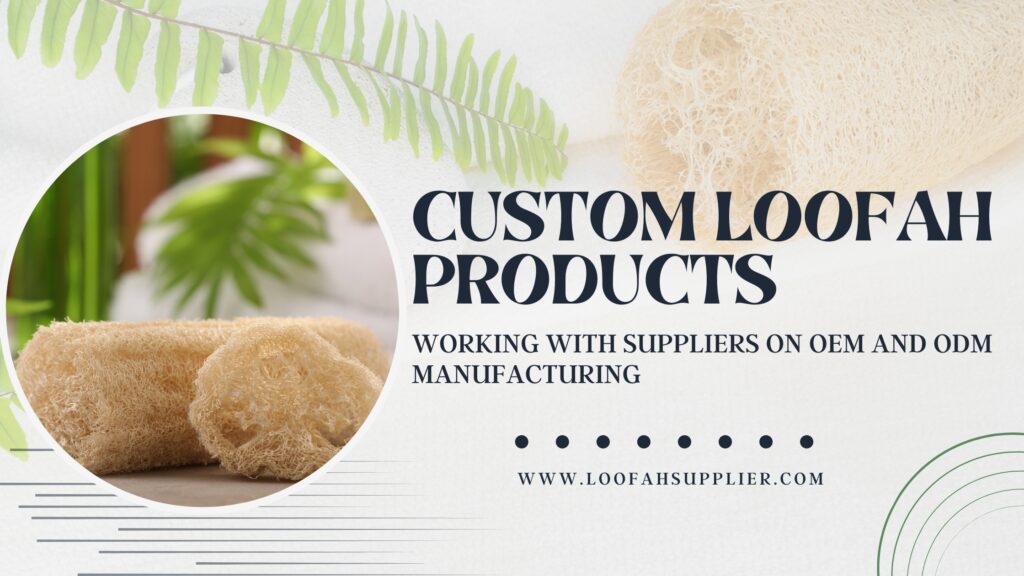
Behind every branded loofah you see on a spa shelf or in a zero-waste subscription box, there is usually a manufacturing partnership that made it possible. Finding the right custom loofah OEM ODM supplier is the single most important decision a brand can make when entering this market, and understanding how these partnerships work also helps everyday consumers appreciate the craftsmanship and sourcing ethics behind the products they choose.
OEM stands for Original Equipment Manufacturer, where a supplier produces products based on your exact design specifications. ODM stands for Original Design Manufacturer, where the supplier contributes product design expertise alongside production. Both models allow brands of all sizes to bring unique loofah products to market without building their own cultivation and manufacturing infrastructure from scratch.
Whether you are a spa owner looking to develop a signature exfoliation line, a retailer wanting to offer private label bath accessories, or simply an eco-conscious shopper curious about how your favorite loofah was made, this guide covers everything you need to know. You will learn how to evaluate suppliers, understand how custom orders work, and see why Egyptian loofah is softer, with a looser fibre weave than Asian loofah.
EGEXO has exported Egyptian loofah since 2015 and offers private label and custom products. Its loofah comes from its own farms and partner farms in the Nile Delta and is processed in its own factory.
If you already know what you need, you can request a wholesale quotation from EGEXO to get started right away.
What OEM and ODM Mean in the Loofah Industry
Before diving into supplier selection and product development, it helps to understand exactly what these two manufacturing models involve and how they serve different goals.
OEM Loofah Manufacturing Explained
In an OEM arrangement, the brand provides the product design, dimensions, packaging specifications, and branding elements. The supplier then manufactures exactly to those specifications. This model works well for established brands that already have a clear product vision and need a reliable production partner to execute it at scale.
A spa chain that has developed a proprietary oval-shaped body loofah with specific thickness requirements, for example, would work with an OEM supplier to produce that exact product. The supplier handles cultivation, processing, cutting, shaping, and packaging according to the brand’s blueprint.
ODM Loofah Manufacturing Explained
ODM goes a step further. The supplier not only manufactures but also contributes to product design, material selection, and product development. This is ideal for brands entering the loofah market for the first time, retailers looking to quickly launch a private label line, or entrepreneurs who want expert guidance on what products will perform best in their target market.
With an ODM partner like EGEXO, you can start from standard sizes or send your own dimensions, for applications from bath and body care to kitchen cleaning to pet grooming.
OEM vs ODM Comparison for Loofah Products
| Factor | OEM Model | ODM Model |
|---|---|---|
| Product Design | Provided entirely by the brand | Developed collaboratively or by the supplier |
| Brand Control | Maximum control over every specification | Shared input with supplier expertise guiding decisions |
| Time to Market | Longer due to custom tooling and prototyping | Faster because supplier has existing product frameworks |
| Ideal For | Established brands with clear product vision | New entrants, private label launches, rapid expansion |
| Minimum Design Investment | Higher upfront design and development costs | Lower because supplier absorbs design overhead |
| Customization Depth | Fully custom shapes, sizes, and features | Modifications to existing proven designs |
| Supplier Expertise Required | Production expertise primarily | Production plus design and market expertise |
Summary: OEM is best when you already know exactly what you want produced. ODM is best when you want a knowledgeable supplier to help you develop the right product for your market. Many successful partnerships blend elements of both models.
For consumers, understanding this distinction helps explain why two brands might sell loofahs that look different but come from the same high-quality Egyptian source material. The customization happens at the design and finishing stage, while the raw loofah quality depends entirely on the growing region and supplier standards.
Have your own design in mind? Tell EGEXO about your private label project. We work from 1,000 units.
Why Working with a Custom Loofah OEM ODM Supplier Matters
Choosing to develop custom products rather than reselling generic loofahs transforms how a brand competes and how consumers experience the final product. The benefits ripple through the entire value chain.
Competitive Advantages for Brands and Retailers
The natural personal care market is crowded. Generic loofahs sourced from unverified origins compete primarily on price, which creates a race to the bottom that hurts margins and brand perception. A custom loofah OEM ODM supplier relationship allows brands to differentiate on design, quality, packaging, and storytelling.
Custom products also create stronger customer loyalty because shoppers associate the unique product experience with your brand rather than treating it as interchangeable with any other loofah on the shelf.
EGEXO’s private label loofah manufacturing services make this process accessible even for brands just getting started. Private label starts from 1,000 units.
Quality and Sustainability Benefits for Consumers
When a brand works directly with a transparent custom loofah OEM ODM supplier, the end consumer receives a product with verified origin, documented quality standards, and traceable sustainability credentials. Compare that to mass-produced loofahs from anonymous factories where growing methods, processing chemicals, and labor practices remain completely unknown.
Custom manufacturing also allows brands to specify minimal packaging, which matter deeply to eco-conscious shoppers. Every custom product from EGEXO starts with Egyptian loofah from our own farms and partner farms in the Nile Delta. Our standard loofah is not bleached. Bleaching is done only on request. You can learn more about this journey through their farm to export process documentation.
How to Choose the Right Custom Loofah OEM ODM Supplier
Not every supplier that offers OEM or ODM services delivers equally. The difference between a good partnership and a costly mistake often comes down to asking the right questions and evaluating the right criteria before placing your first order.
Supplier Evaluation Checklist
| Evaluation Criteria | What to Verify | Why It Matters |
|---|---|---|
| Cultivation Experience | Years in loofah farming, region of origin, farming methods | Directly determines raw material quality and consistency |
| Vertical Integration | Does the supplier control farming, processing, and export | Reduces supply chain risk and ensures quality oversight |
| Custom Design Capability | In-house design team, prototyping ability, sample turnaround time | Determines how effectively they can execute your vision |
| MOQ Flexibility | Minimum order quantities for different product types | Critical for new brands testing the market |
| Certifications | Phytosanitary, ISO, export documentation | Required for import compliance in most markets |
| Communication Responsiveness | Response time and language capabilities | Affects every aspect of the ongoing relationship |
| Sample Program | Availability and cost of pre-production samples | Essential for quality verification before commitment |
| Packaging Options | Custom packaging, labeling, and branding services available | Determines whether you need additional packaging vendors |
| References and Track Record | Client testimonials, export history, market presence | Validates claimed capabilities with real-world evidence |
EGEXO has exported Egyptian loofah since 2015 to customers in more than 40 countries. Its loofah comes from its own farms and partner farms in the Nile Delta and is processed in its own factory. Read why buyers choose EGEXO.
Red Flags to Watch For
Certain warning signs should make any buyer pause during supplier evaluation. Suppliers who cannot name their loofah growing region, refuse to provide samples before bulk orders, have no published quality standards, or give vague answers about processing methods are not operating with the transparency that custom manufacturing demands.
Similarly, extremely low pricing almost always signals compromised quality. When a supplier’s per-unit cost falls far below the industry norm, the savings usually come from inferior raw materials, chemical shortcuts in processing, or inconsistent quality control. For consumers, this translates to loofahs that fall apart quickly, feel rough or uneven, or potentially contain chemical residues from bleaching treatments.
How to Start the Conversation with a Supplier
The first interaction with a potential custom loofah OEM ODM supplier sets the tone for the entire relationship. Come prepared with answers to these questions your supplier will likely ask.
What product types are you interested in developing? What is your target market and intended retail positioning? What are your estimated annual volume requirements? Do you have existing product designs or do you need ODM support? What certifications or compliance standards does your market require? What is your target timeline for first production?
Having clear answers accelerates the quoting process and signals to the supplier that you are a serious partner worth investing their time in. You can request loofah samples from EGEXO to start evaluating quality before entering detailed discussions. Samples are paid and the buyer pays the shipping. The sample cost is credited to your first order of $1,000 or more, placed within 60 days.
The Custom Loofah Manufacturing Process from Concept to Delivery
Understanding each stage of the manufacturing process helps both business buyers plan realistic timelines and consumers appreciate the craftsmanship behind custom loofah products.
Custom and private label orders take longer than standard products: the time is confirmed with the quote. Standard products are ready in 7 to 25 days from payment.
EGEXO’s custom loofah product design services help brands turn a logo, idea or reference into a finished product. EGEXO designs the packaging layout, and options cost extra.
Quality Control Throughout Production
Quality is not something that gets checked only at the end. In a well-run custom manufacturing operation, quality control happens at every stage. At EGEXO, every product is checked before packing. See its quality standards.
Egyptian Loofah as a Raw Material for Custom Products
The raw material determines everything. No amount of clever design or attractive packaging can compensate for a loofah made from low-quality fiber. Egyptian loofah from the Nile Delta region is softer, with a looser fibre weave than Asian loofah, and this matters in custom product development.
What Makes Egyptian Loofah Different
Egypt’s Nile Delta has fertile alluvial soil, reliable irrigation, and strong sunshine. Egyptian loofah is softer, with a looser fibre weave than Asian loofah.
Explore EGEXO’s range including raw loofah scrubbers and body loofah products.
Popular Custom Loofah Product Categories and Specifications
Understanding what types of custom products are possible helps brands identify their best market entry point and helps consumers appreciate the range of what natural loofah can do.
Products can be customized with branded packaging, custom shapes, and tailored sizing. Private label options include embroidered or printed labels, hang tags and custom packaging, from 1,000 units. EGEXO supports this through its custom product design service.
Custom Packaging and Branding Options
The packaging around a custom loofah product matters almost as much as the loofah itself. Today’s eco-conscious consumers actively reject excessive plastic packaging.
Common custom packaging options include kraft paper wrapping with printed labels, recycled cardboard boxes with brand artwork, cotton drawstring bags for gift-ready presentation, compostable cellophane wraps for retail display, and minimalist paper belly bands for a clean shelf appearance. Private label options include embroidered or printed labels, hang tags and custom packaging. EGEXO designs the packaging layout from your logo, idea or reference.
If you are ready to start developing your custom loofah product line, request the priced catalog on egexo.com for an overview of available products and sizes.
Advice from EGEXO
Since 2015, we have exported Egyptian loofah from the Nile Delta and made custom products for brands. The most successful partnerships share one trait: clear communication from day one. Brands that invest time in a detailed product brief, specify their quality expectations upfront, and commit to thorough sample evaluation before bulk production consistently achieve better results and faster timelines. We encourage every new partner to start with a sample order so they can feel the loofah themselves. Samples are paid, the buyer pays the shipping, and the sample cost is credited to your first order of $1,000 or more, placed within 60 days. Custom manufacturing is a collaborative process, and the best outcomes happen when both the brand and the supplier treat it as a true partnership rather than a simple transaction. Request a quote from EGEXO
Frequently Asked Questions
Q1: What is the difference between OEM and ODM loofah manufacturing?
OEM loofah manufacturing means the supplier produces products exactly to your provided designs and specifications. ODM means the supplier also contributes product design and development expertise. OEM offers maximum brand control while ODM provides faster time to market with less upfront design investment. Many brands start with ODM to leverage supplier knowledge, then transition to OEM as their product line matures and their design capabilities grow. A quality custom loofah OEM ODM supplier like EGEXO supports both models.
Q2: What is the typical minimum order quantity for custom loofah products?
There is no minimum order on standard products. Private label, custom packaging and custom products start from 1,000 units. Options cost extra.
Q3: How long does the custom loofah product development process take?
Custom and private label orders take longer than standard products. The time is confirmed with the quote. Standard products are ready in 7 to 25 days from payment.
Q4: Why use Egyptian loofah for custom manufacturing?
Egyptian loofah from the Nile Delta is softer, with a looser fibre weave than Asian loofah.
Q5: What certifications should a custom loofah OEM ODM supplier provide?
Essential documents include a phytosanitary certificate confirming pest and disease-free status and a certificate of origin. EGEXO’s management system is certified to ISO 9001, 14001 and 45001, and its good manufacturing practices to ISO 22716. We hold an Export License. Always request these documents during supplier evaluation.
Q6: How can I verify the quality of custom loofah samples before placing a bulk order?
Evaluate samples across five key criteria: fiber density by examining how tightly packed the fibers are, flexibility by bending the loofah to test resilience, color uniformity by comparing multiple samples from the same batch, wet performance by testing how the loofah feels after soaking, and durability by using the sample daily for at least one week. A premium Egyptian loofah sample should feel firm yet flexible, display consistent coloring, soften pleasantly when wet, and show minimal fiber loss after a week of use.
Q7: What does EGEXO offer as a custom loofah OEM ODM supplier?
EGEXO has exported Egyptian loofah since 2015 to customers in more than 40 countries. Its loofah comes from its own farms and partner farms in the Nile Delta and is processed in its own factory. It offers private label and custom products from 1,000 units, and no minimum order on standard products.
Conclusion
Custom loofah product development through OEM and ODM manufacturing partnerships opens doors for brands seeking market differentiation and for consumers seeking better, more transparent products. The process is more accessible than many people assume, particularly when working with an experienced supplier that controls the entire production chain from cultivation to export.
Egyptian loofah is softer, with a looser fibre weave than Asian loofah, and EGEXO has exported it since 2015, with private label and custom products from 1,000 units.
Key Takeaways:
- OEM manufacturing executes your exact product design while ODM adds supplier design expertise to accelerate development and reduce upfront investment.
- A thorough supplier evaluation covering cultivation experience, quality standards, certifications, and sample programs protects your brand and your customers.
- Egyptian loofah from the Nile Delta is softer, with a looser fibre weave than Asian loofah.
- Every custom manufacturing decision made with transparency and quality in mind ultimately benefits the end consumer.
Ready to develop your custom loofah product line?
- For Wholesale Buyers: Request a quote or download our catalog
- For Samples: Request samples
Keep reading: private label loofah supplier and requesting samples first.